

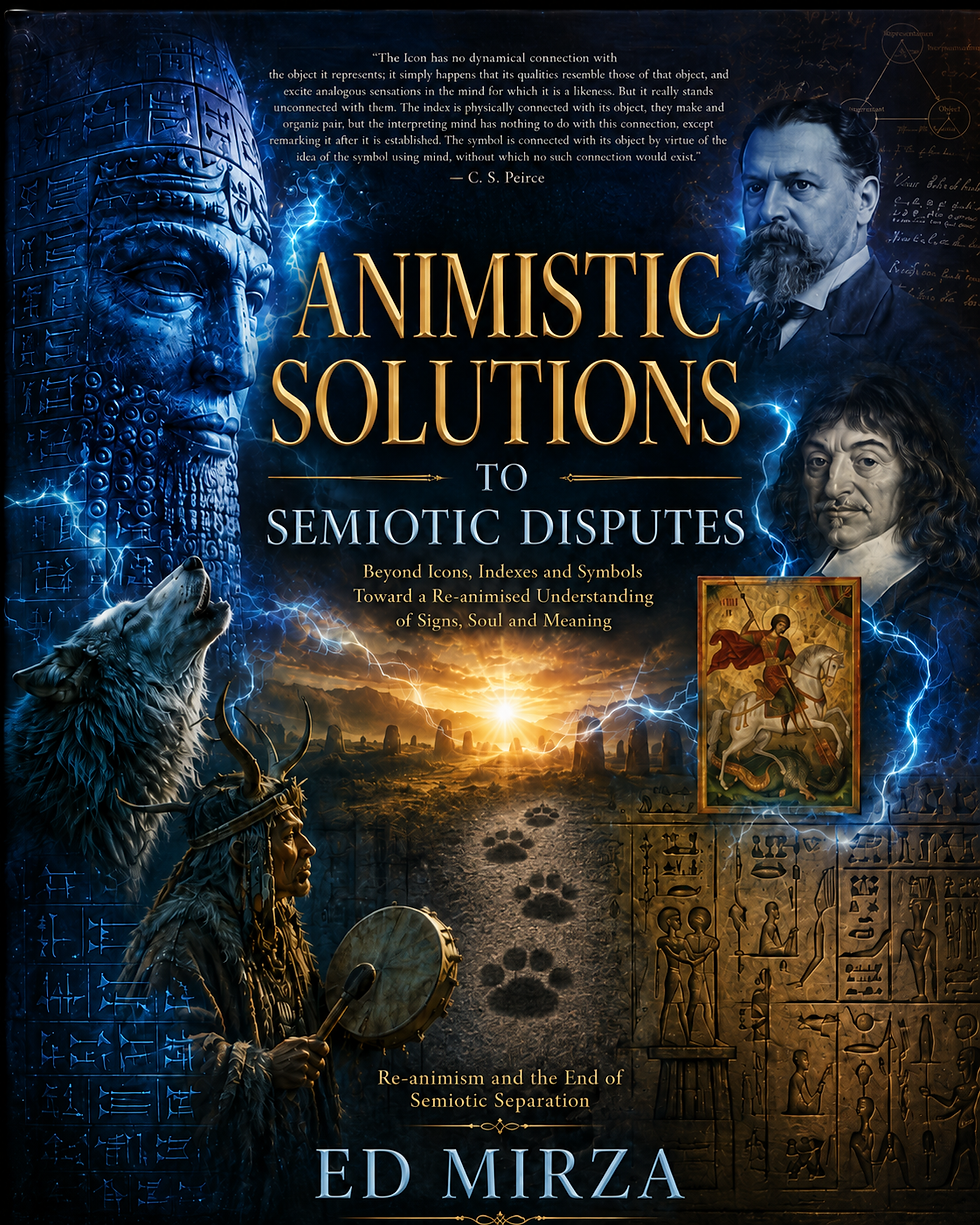
Animistic Solutions to Semiotic Disputes
Author: Ed Mirza
Genre: Speculative philosophy / Aesthetics / Metaphysical reflection
Themes: Painting, light, perception, memory, time, consciousness, animism
Archival edition: Zenodo / Philosophy record: PhilPapers
The Post-Cartesian Disembodied World
The post-Cartesian world has often been seen as deficient in precisely those qualities which seem hardest to separate and quantify. When thinking is prized as the primary modality of being — I think, therefore I am — there is a corresponding danger that empathy, intuition and the body become depreciated. The thinking consciousness appears somehow to stand apart from the world it observes: mind from body, observer from observed, present from past, word from thing.
This is necessarily a simplification of Descartes, but Cartesianism remains a useful emblem of a certain habit of thought. Analysis separates. It distinguishes one quality from another in order to understand each more clearly. Yet there is always a danger that the separation required for analysis begins to be mistaken for a separation which actually exists in the world.
The result can be a strangely disembodied picture of experience. Things become isolated units; people become individual thinking centres; history appears as something external to the present; and representation becomes a system by which detached symbols somehow communicate information between otherwise separate entities.
Animism begins from almost the opposite intuition.
The Thoroughgoing Animism of Previous Times — Analysed in Its Ultimate Implications
Earlier cultures frequently treated marks, images, names and objects in ways which now appear explicitly magical or totemic. Frazer's enormous catalogue of sympathetic and contagious magic in The Golden Bough, Edward Burnett Tylor's discussion of animism, and Freud's later consideration of animistic thinking all describe, from very different perspectives, worlds in which resemblance, contact, image and name were understood to possess a significance exceeding simple representation.
An image might not merely depict its subject but could in some sense participate in it, so that representation is not a neutral act of copying but a continuation of presence in another form. A relic, in this sense, is not simply an object left behind but something that still carries a trace of the person from whom it came, as though a portion of their being persists within it. A lock of hair similarly does not sever connection at the moment of separation, but remains bound to the individual in a way that exceeds physical detachment.
In the same way, a picture, name or emblem may be understood as bearing a kind of charge derived from what it represents, accumulating significance through its relation to a living or once-living source. A word, then, is not merely a label that denotes from a distance, but can function as something that invokes, calling forth presence, memory or effect rather than simply pointing towards an absent object. Totemic figures themselves were of course understood in some cultures as participants in precisely such relations, and could therefore become instruments of shamanistic, ritual or magical practice.
Taken to its fullest implication, however, animism leads into stranger territory.
The Lion in the Sky
Suppose I look into the sky and see a cloud shaped like a lion. No physical lion made the cloud. Nobody deliberately constructed the resemblance. Nevertheless there is now an event in the universe which can properly be described as: I saw a lion in the sky.
At the ordinary material level, thought is certainly not nothing. Thinking requires a living brain, metabolism and energy. Neural events occur, while physical processes accompany perception, memory and imagination. Whatever conclusions one draws about consciousness itself, the thought has occurred within the space-time history of the universe. It corresponds with physical processes involving measurable quantities of energy — ultimately expressible in joules — even if the precise energetic cost of an individual thought cannot simply be isolated and read from a meter.
Animism makes the more radical speculative move. If everything possesses some form of life, presence or soul, then thoughts cannot simply be excluded from this condition. A thought-form must itself possess some manner of being.
The lion-cloud therefore participates not simply in one particular zoological lion but in the enormous human field of lion: living lions, remembered lions, painted lions, heraldic lions, mythological lions, childhood lions, religious lions and every previous image through which the form has acquired meaning. More strongly still, within a thoroughgoing animistic account the cloud-lion does not acquire this participation merely because somebody subsequently photographs, remembers or describes it. It is itself now an entity within this interactive field of lion — alongside lions themselves, depictions of lions and previous thoughts of lions. Subsequent memories, photographs and descriptions create further extensions of that participation; they do not constitute its original reality.
Every thought and association may therefore possess a similar life. It can be represented again by sound, image, word, gesture or memory, and every further representation carries something of the participation and presence of the thing which preceded it.
These are among the ultimate implications of animism.
The Evocative Impact of Literature
It follows that reading a book, listening to a song or hearing another person describe an experience may establish a form of participation in the symbolic lineages they communicate. Their words or sounds enter a consciousness already populated by memories, images and associations, and become interwoven with them. Something originating in one experience is therefore reflected, however imperfectly and attenuatedly, within another.
If words and signs are merely detached marks which trigger learned associations, how do a few marks on a page create such extraordinary experiences in a reader — people, places, memories, love, terror, entire imagined worlds? What exactly is happening when literature moves us?
Humans as Die-Hard Animists
Human beings behave continually as though history adheres to things. We preserve objects which may be almost worthless in themselves because of what has happened to them. An old bus ticket might be kept because it came from the journey on which somebody travelled to see the person they loved; decades later it can summon the journey, the weather, the anticipation and the face of the person waiting at the other end. Nothing in the typography of the ticket resembles love, and yet the ticket has become charged. Its material insignificance seems almost beside the point beside the history it has acquired.
We behave similarly towards photographs and familiar objects. It can feel unpleasant to scratch out the eyes of somebody one loves in a photograph, although no physical injury can possibly be inflicted upon the person represented. We name cars, slam a door too violently and almost feel that we have hurt the vehicle; we shout at computers, plead with machines, preserve childhood toys and keep the detritus of people who have died. We know perfectly well that these things are not alive according to ordinary biological criteria, while simultaneously behaving towards them as though personality, history or presence somehow adheres to them. Human beings are, in this respect, remarkably die-hard animists.
Perhaps this tendency is merely an evolutionary or psychological residue, a persistence of an earlier habit of mind which rational consciousness has never quite succeeded in extinguishing. But perhaps its persistence tells us something about the actual structure of human experience: that we do not naturally encounter the world as a collection of isolated and neutral objects, but as things already carrying relationships, memories and histories. For such resolutely and instinctively animistic creatures, how are we really to understand the effect of a book such as War and Peace? If marks and objects are really as dead as our analytical descriptions suggest, how can they create so much life?
The End of History and the Blank Canvas
A philosophical culture accustomed to treating representation as the detached manipulation of abstract signs may reinforce a wider habit of imagining persons, histories and objects as similarly separable. The individual begins to resemble a blank canvas, while history is placed outside the person as information which may simply be accepted, rejected or replaced. Inherited meanings can then appear to be arbitrary constructions, and the body itself becomes less important than the supposedly abstract consciousness inhabiting it. Qualities rooted in history, culture, memory and inherited association risk being treated as superficial additions to an otherwise neutral human unit.
An animistic model points in almost the opposite direction. Things trail histories; words trail histories; people trail histories. An object enters consciousness already participating in other objects and events, just as a person enters the present carrying relations to bodies, families, languages, memories, places and previous generations. This need not imply that identity is fixed, or that change is impossible. It suggests instead that change itself takes place within continuity: new relations are established upon older ones rather than beginning from an entirely empty ground.
Thoughts and Visual Representations as Bodies in the Universe
If animism is followed in a thoroughgoing manner, through all its implications, thought itself cannot simply be excluded from the category of living entities. A vivid thought unquestionably corresponds with physical events in a living organism: energy is consumed, neuronal activity takes place, and something has happened in the history of the universe which would not otherwise have happened. It has a physical correlate involving measurable quantities of energy. Animism asks whether this occurrence should be regarded merely as an incidental by-product of matter, or whether a thought-form possesses some participatory field and continuity of its own.
Consider, for instance, a belief in an afterlife. It would be too simple to argue that believing in an afterlife thereby demonstrates the physical existence of one. Yet the thought-form itself unquestionably exists and, in an important sense, is already real within the register proper to it. More than this, it possesses a participatory field of its own: an imagined universe of forms, relations and possibilities into which people may enter through belief, memory, ritual, fear, hope or representation. It generates images, architecture, literature and ceremony; it consoles people, directs actions and has contributed to buildings, institutions and even conflicts. These effects do not create the reality of the thought-form, but constitute further interactions within, and extensions of, the field it already possesses. The belief may originate within an individual consciousness, but it does not remain there: it enters other minds, acquires representations, develops histories and persists through time. Different registers of reality can therefore coexist without being regarded as identical.
Popular fiction repeatedly takes the more extreme step of imagining thought acting directly upon physical reality. In The Medusa Touch, Richard Burton's character apparently causes buildings and other structures to collapse through the sheer concentration of thought. On the ordinary physical register, of course, the buildings have not actually collapsed. Yet the destruction as a thought-form is not therefore nothing: it has existed as a definite imaginative event, with a physical correlate in the brains and bodies which conceive or experience it, involving measurable energetic processes. Within an animistic account it possesses a reality and participatory field of its own. The filming, viewing and remembering of that destruction do not make the thought-form real; they become further ways in which other people participate in it and extend its lineage.
In this sense something has happened, although not in the same register as an actual building collapsing. The imagined catastrophe can be entered, repeated, remembered and transmitted. This offers one route into the older idea of intention and the modus operandi of totemic magic: thought is not simply nothing until converted into physical action, but is already an event with which other entities can participate and which can itself enter and affect further events.
The World of Semiotics — A Seminal Figure
The modern study of signs has one of its great seminal figures in Charles Sanders Peirce. Semiotics attempts, among other things, to understand how one thing can come to represent another: how language, images, gestures, traces and symbols acquire meaning. Peirce's famous distinction identifies three important modes of signification — the index, the icon and the symbol — and thereby offers a particularly useful point of entry into the animistic problem.
An index possesses an actual relation to its object: a footprint has been caused by a paw, and smoke is connected with fire. An icon operates principally through resemblance: a portrait resembles its sitter, while a diagram resembles certain relations which it describes. A symbol, by contrast, operates primarily through convention, law or habit. The written word lion neither looks like a lion nor has normally been physically produced by one, yet English speakers understand what it signifies.
Peirce himself was considerably subtler than this three-part summary suggests. Signs can combine these different qualities, and his thinking about their classification continued to develop and undergo revision throughout his career. Nevertheless the categories provide the useful analytical cut. Three qualities of representation have been distinguished from one another. The question which concerns us is rather different: what happens when, instead of concentrating upon their separation, we examine the continuity running between them?
Older Attitudes to Words, Intonations and Representations
In older magical traditions the distinctions between picture, word, sound and object could be considerably more fluid. A name might participate in the named, a sigil embody an intention, and a sacred inscription do more than convey information. Letters themselves could be contemplated as powers: their order, repetition and sounding might matter. In Kabbalistic traditions particularly, combinations of letters and sacred names could become subjects of mystical contemplation and magical speculation, while chants, invocations and incantations in many traditions similarly treated sound as something efficacious rather than merely descriptive.
The scribe in such a world was therefore performing something closer to a magical act. Marks could make the absent present, and the distinctions between word, image and object were not necessarily experienced according to the categories preferred by modern analysis. This differs markedly from a tendency to categorise mark, image and symbol in a way which begins to suggest that these aspects of representation can ever exist in complete isolation. Their persistent refusal to do so may itself point towards the equally persistent animistic condition beneath them: an underlying continuity of participation.
The Unbroken Lineage Between Different Qualities of Mark — Peirce's Different Aspects of Representation
Consider again the footprint. It is Peirce's archetypal indexical kind of mark because an animal has physically impressed itself upon the earth. Yet the footprint is already also an image: it possesses the shape of the paw and resembles what produced it. Now somebody draws the footprint. The new representation no longer contains the physical indentation made by the animal, but it resembles the original trace and, through that trace, the paw itself. Physical immediacy has diminished, but the lineage has not disappeared.
The drawing may then be copied, stylised and simplified. Eventually it becomes an emblem, and the emblem may grow increasingly schematic until a mark remains which nobody could recognise as a paw without being taught its meaning. At this point it operates predominantly as a symbol. Yet where precisely did the original relation disappear? There is an unbroken chain from trace to picture, from picture to stylised image, and from image into abstraction. Each stage becomes more attenuated, but each descends from what preceded it.
This is the important point. The distinction between index and icon, or between icon and abstract symbol, may be perfectly useful for analysis without corresponding to an absolute break in the history of the representation itself. The relation changes its character and becomes increasingly mediated, but there is no necessary moment of severance. What analysis presents as several categories may therefore prove, when followed historically and experientially, to be different registers within one continuing participatory lineage.
The Key Is Continuity
It is by zooming in on this continuity — by following it rather than the divisions imposed upon it — that something strange begins to happen. The problem moves beyond the classification of signs and into another field, in which it becomes progressively more difficult simply to dismiss the claims and implications of a thoroughgoing animism. The categories remain visible, but beneath them an unbroken structure of relation begins to emerge.
Dead Switches
A certain way of talking about signs can nevertheless make them appear like dead switches. A mark is perceived, recognised as a representation, matched with a stored association and followed by a neurological response; then another mark appears and another switch is pressed. By such means we are apparently to understand how enormous emotional and imaginative experiences arise from books, paintings and music. Nothing in this mechanical description need necessarily be false, but it can seem startlingly inadequate to what is actually experienced.
Perhaps some of this inadequacy arises because the act of analysis has caused the underlying continuity to disappear. Once we recognise that an indexical mark is already an image, while an image is never entirely isolated from symbolic associations, the apparent separation begins to break down and the continuing participation with the original subject becomes palpable again. Peirce himself increasingly complicated his classifications and acknowledged mixtures between different modes of signification. This does not invalidate his categories; it may instead suggest that they are analytical abstractions taken from a phenomenon which remains fundamentally continuous.
Analysis has made the cuts; the phenomenon itself has not necessarily obeyed them.
Humans as Factors in the Field of Meaning
Peirce occasionally goes surprisingly far in dissolving the distinction between human beings and signs. Human thought, in his account, develops through signs; language develops through human usage; and people themselves are altered by the languages and symbols which they inherit. His striking observation that words and human beings “reciprocally educate” one another captures something of this mutuality: words accumulate information and resonance through the history of their use, while people acquire forms of thought through those same words.
The human being, therefore, is not simply standing outside the symbolic field and decoding it. The human is one of its participants. This connects curiously with animism, because things which initially appear to belong to entirely different orders may reveal comparable forms of existence when considered according to different criteria. A human being is biologically alive in a way that a word plainly is not, but the human is also a sign: a name, body, face, biography and identity carry meanings for other people. Likewise a thought-form is not alive in the biological sense of the person who thinks it, yet it can persist, reproduce, alter, enter other consciousnesses and accumulate a history.
We begin, therefore, to speak less simply of life and non-life than of different forms and registers of continuity. Participation precedes interpretation; interpretation makes that participation meaningful, but interpretation also creates new participation. The footprint enters consciousness; consciousness produces an image; the image may become a word; the word enters another consciousness. Each stage develops out of what preceded it, adding something while preserving a lineage.
The Participatory Field of Experience
Language and world therefore begin to fall apart as absolutely distinct territories. We move through a world of symbols possessing personal significance, while those symbols continually interact with other symbols already within us. A street recalls a person; the person's name recalls a room; the room recalls a smell; the smell recalls childhood. A particular sentence may suddenly restore the presence of a dead parent, while a piece of music can recover the emotional atmosphere of an entire period of life. Public symbolism and private memory are continually interwoven.
Meaning might therefore be understood as progressing through a participatory field of experience. Every individual possesses a particular history — an arrow through time — within which representations accumulate, interact and acquire new meanings, yet these individual histories continuously overlap with larger collective ones. The word mother existed before my mother, and the symbolic form of the lion existed before I encountered a lion myself. Such forms enter private histories from collective ones, after which our own uses, experiences and memories add something further to them.
If animism is followed to its strongest implications, these forms may themselves possess some manner of life and memory: not necessarily consciousness in the human sense, nor biological metabolism, but continuity, effect, inheritance and participation. Animism would then become, in part, a way of speaking about different forms of life and persistence within the same world.
Words become instruments of light in such an animistic field.
Absolute Compartmentalisation
The problem with Peirce is therefore not principally that the categories of index, icon and symbol are wrong. They identify genuinely useful qualities of representation. The difficulty arises when their analytical isolation encourages the impression that they correspond with absolutely separate kinds of existence. Peirce distinguishes direct physical trace, resemblance and conventional signification; but if the continuities connecting those registers are followed through to their fuller implications, an underlying lineage becomes visible.
The paw participates in the footprint; the footprint participates in the drawing; the drawing participates in the stylised image; the stylised image participates in the emblem; and the emblem participates in the symbol. Each stage may stand increasingly remote from physical contact with the original, but remoteness is not the same as non-relation. What appears as compartmentalisation may therefore belong principally to the act of analysis rather than to the metaphysical condition of representation itself.
Implied Continuity of Indexicality
The central proposal of this essay is therefore that indexicality, if understood more broadly as participatory continuity, is never entirely absent. Peirce reserves the term index for a particular kind of actual or existential relation, and this terminology remains useful; but the footprint reveals a condition which does not necessarily disappear merely because representation changes register. Once the footprint is drawn, its immediate physical causality has been attenuated, but the drawing still descends from the footprint. Once the drawing is stylised into an emblem, resemblance may diminish, but the emblem still possesses a lineage.
Even an entirely arbitrary symbol does not escape the principle altogether. If △ is arbitrarily declared to mean lion, there may previously have been no relation between the two. After the declaration there is one. If a million people learn the association, that relationship has entered a million individual histories and has acquired a collective existence.
Arbitrariness describes how the connection originated; it does not make the resulting connection unreal. Following the transition from footprint to picture, stylised image, emblem and finally arbitrary sign, there is no obvious point at which a living relation suddenly becomes a dead one. Semiotics isolates the different modes; animism notices what continues between them.
This may, at least at one level, be understood as an attenuated participation: as the symbol becomes more abstract, particular forms of immediacy or resemblance may diminish, while the underlying participatory lineage remains.
The Name of That Continuity Is Participation
The apparent break is produced by analysis; the underlying experience is continuous. The name I give to that continuity is participation. Participation need not possess equal strength in every case. A footprint has extraordinary causal proximity to the paw; a photograph participates through light; a painting through perception, memory, judgement and gesture; a copied image through an earlier image; a word through inherited usage; a keepsake through personal history; and an arbitrary symbol through intentional association. All of these partake in an unbroken lineage within the participatory field of their subject, while each in turn establishes a participatory field of its own.
It is therefore possible to speak of attenuated participation, without implying that participation can be reduced to a single measurable quantity. Different properties — visual resemblance, causal proximity, historical continuity, personal association or collective reinforcement — may persist to differing degrees, but these are secondary characteristics of a more fundamental condition: the representation remains situated within the participatory field of its subject. Emotional charge and resemblance may fluctuate; the lineage itself need not therefore disappear. Different representations may stand at very different distances from their origins without the underlying relation ever necessarily becoming zero.
Attempts to categorise the mechanics of language and the apparatus of meaning can therefore become informed by a wilful severance of word from image, symbol from trace and representation from represented. Animism proposes a different conclusion. The cut is analytical; the continuity is metaphysical.
The Experience of Literature
And this returns us to the earlier question: how does a book work? Consider War and Peace. A reader sits before marks on paper or pixels on a screen. There is no Moscow in the room, no Natasha, Pierre or Prince Andrei; no ballroom, cavalry or snow-covered retreat. Yet these things become present. Fictional people acquire personalities and histories, while an absent battlefield becomes terrifying. A writer dead for more than a century continues to produce images and emotions in living minds. A disenchanted account can describe letters being recognised, meanings retrieved and associations activated, but it still leaves us with the remarkable spectacle of dead switches producing an inhabited world. Where did that world come from?
Animism begins elsewhere: the word does not arrive alone, but carries previous usages, images, memories and histories into a consciousness already populated by others. Tolstoy's war meets the reader's own images of war, and something new emerges. Characters likewise accumulate history as the novel proceeds; Natasha has, in a peculiar sense, lived within the reader's imagination. Literature becomes a participatory field in which something travels across language, printing, translation, memory and time without the lineage being broken. Words are instruments of light: they make absent things present. If War and Peace were only a sequence of dead switches, we might reasonably ask: where did the world come from?
This one really knocked my socks off!