


Scholarly Articles and Reflections
Explorations in philosophy, cultural critique, and the deeper architectures of knowledge.
My writing engages with the human condition through the prisms of art, philosophy, psychology, and social structures. Whether reflecting on the illusions of professional gatekeeping, the myth-making power of visual art, or the paradoxes at the heart of modern labour, my essays are an invitation to think more freely and more clearly.
These articles appear in stages—some are full essays, others are short-form provocations or working drafts shared in public academic repositories like Zenodo, PhilPapers, and SSRN, to formally timestamp ideas and open them to dialogue. A selection is also published in the Aqua Alta cultural magazine.
The Funny Little Doggy's Riposte to Richard Dawkins
Genre: Philosophical allegory / Thought experiment
Themes: Consciousness, materialism, paradox, identity
Summary:
A playful yet piercing philosophical tale set at Hammersmith Station, where a talking dog confronts a fictionalized Richard Dawkins with the question: If consciousness arises from matter, why is “my” consciousness in “this” body rather than another? The work explores the paradox of discrete consciousness and critiques strict materialist views from a position of speculative humility

Read on Zenodo / PhilPapers
A Phenomenological Disproof of Descartes' Cogito
Genre: Philosophical critique / Phenomenology
Themes: Certainty, embodiment, rationalism vs. experience
Summary:
This essay reconsiders the foundation of Descartes' epistemology. It proposes that thought is not the only indubitable experience; instead, sensation, emotion, and non-rational awareness offer equally foundational certainties. Building on phenomenology, the work reframes the cogito into a broader claim: "I experience, therefore I am."
Read on Zenodo / PhilPapers – link forthcoming

A New Theory of Gravity: Density, Time Dilation, and Transformation Fields
Genre: Theoretical physics / Conceptual science
Themes: Gravity, density, time, relativity, metaphysics
Summary:
An intuitive model of gravity based not on spacetime curvature, but on density and the transformation fields surrounding massive objects. The theory offers an explanation for gravitational pull, time dilation, and motion using compression dynamics, and proposes new pathways for reconciling general relativity and quantum behaviour.
Read on Zenodo / PhilPapers – link forthcoming

Primer to the Greats: A Self-Education Blueprint
Genre: Educational manifesto / Literary curation
Themes: Cultural literacy, gatekeeping, intellectual autonomy, great books
Summary:
A curated intellectual journey for those excluded from elite education. This primer offers nine foundational texts—from The King James Bible and The Koran to Ulysses and War and Peace—with commentary on why they matter, how to approach them, and what they offer as tools of thinking. The piece doubles as a critique of academic gatekeeping and a manifesto for reclaiming deep cultural knowledge on one's own terms.

Read on Zenodo / PhilPapers
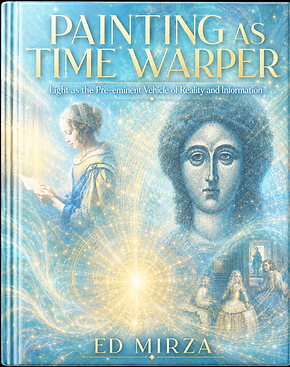
Painting as Time Warper: Light as the Pre-eminent Vehicle of Reality and Information
Genre: Speculative philosophy / Aesthetics / Metaphysical reflection
Themes: Painting, light, perception, memory, time, consciousness, animism
Summary:
Beginning with the strange immediacy of paintings by Velázquez and Vermeer, this speculative essay asks whether painting may sometimes act as more than representation—allowing something of another room, atmosphere and moment to become perceptually present.
Moving through memory, mental imagery, early sound recordings and the subjective experience of time, the essay considers light as painting’s principal carrier of reality and information. From an animistic perspective, it proposes that people, places and events may extend beyond their immediate physical boundaries through images, recollections and later acts of attention. Painting may therefore permit one perceptual moment to remain active within another, creating a faint form of participation across otherwise separate points in time.
Read on Zenodo / PhilPapers
Animistic Solutions to Semiotic Disputes
Genre: Speculative metaphysics / Semiotic critique
Themes: Animism, semiotics, participation, consciousness, representation, meaning
Summary:
This essay asks whether the analytical distinctions we make between signs can obscure a deeper continuity between things and their representations. Beginning with older animistic ideas of sympathetic relation and moving through Charles Sanders Peirce’s distinctions between index, icon and symbol, it proposes participation as an underlying metaphysical principle connecting trace, image, word, memory and thought. From footprints and keepsakes to imagined worlds and literature, the essay explores whether representation may be understood not simply as standing for something absent, but as continuing to participate in what it represents.

Archival edition: Zenodo / Philosophy record: PhilPapers – link forthcoming
New Age Hero: The Eternal Return of the Hero in Art and Literature
Genre: Cultural philosophy / Art and literary history / Speculative psychology
Themes: Heroism, the antihero, self-image, myth, masculinity, virtuosity, art and literature
Summary:
Beginning with The Epic of Gilgamesh and the heroes of Greece, this essay follows the heroic figure through Classical antiquity, Christianity, the Renaissance, Baroque and Neoclassical art, Romanticism, Modernism and the scepticism of the Postmodern age. It asks why the hero repeatedly survives even cultures that appear to reject heroism, and why extraordinary skill, courage and exemplary figures continue to exert such power over the imagination.
The essay ultimately proposes a more fundamental explanation for this persistence. Bringing the history of the hero into dialogue with the formation of self-image, childhood individuation, gender, emulation and the pursuit of mastery, it explores the possibility that heroic figures form part of the way human beings construct and continually revise representations of themselves. The hero, in this account, is not simply an historical type but a mirror: an image against which the self can be imagined, tested and transformed.

Archival edition: Zenodo / Philosophy record: PhilPapers – link forthcoming
The Sensorial Line: The Primacy of the Human Figure in World Art
Genre: Speculative aesthetics / Art theory / Philosophical reflection
Themes: Human figure, drawing, embodiment, Sensorium, Reflection, draughtsmanship, Raphael, Renaissance cartoons, Cubism, Picasso, vibrant kineticism
Summary:
Beginning with Maurice Merleau-Ponty and the idea of the human body as the Sensorium — the locus through which the world is perceived — this essay develops the proposition that the human figure, and particularly the figurative line, occupies a uniquely central position within visual art.
Moving through Walter Benjamin’s concept of Reflection and Oskar Fischel’s writing on Raphael, the essay identifies a Promethean Moment in the development of Renaissance drawing: the emergence of the great cartoons and preparatory drawings of Leonardo, Michelangelo and Raphael as works in which artistic thought itself appears to become visible, and, with Raphael, and artistic Gold Standard attained.
Within the drawings of these masters — and most especially in Raphael — the essay identifies an exceptionally rare “vibrant kineticism”: a vibratory, almost animated quality of line in which bodily perception, accumulated skill, psychological sensitivity and Reflection seem to become condensed. This quality is not presented as characteristic of figurative drawing in general, but as something achieved only at particular heights of draughtsmanship, and later encountered again with extraordinary force in Picasso.
The argument culminates in Picasso and Cubism, understood not simply as a disruption of traditional representation but as an intrinsically Reflective form. Its multiplication of viewpoints, and its simultaneous presentation of different aspects of the same subject, are treated as visual analogues of the shifting, comparative and multiperspectival character of human perception itself.

Archival edition: Zenodo / Philosophy record: PhilPapers – link forthcoming
IT'S NOT THE FORM - It's the Genius
Genre: Speculative aesthetics / Art theory / Philosophical reflection / Exhortation
Themes: Genius, Form, Reflection, artistic originality, critical judgement, Kant, Plato, Romanticism, Renaissance, eclecticism, Picasso, El Greco
Summary:
Beginning with the ancient meaning of Genius as an attendant or guardian spirit, this essay follows the idea into Kant’s proposition that “Genius gives the Rule to art.” It asks what happens when the Forms created by exceptional artists are subsequently identified, classified and turned into standards by critics, followers — and sometimes by the artists themselves.
Moving through Plato’s Eidos, Kantian aesthetics, Romantic Reflection, Postmodern eclecticism and criticism, the essay distinguishes between the living activity that produces a Form and the Rule retrospectively abstracted from it. A discovery may become a style; a style a method; and a method, eventually, a convention. What begins as invention can become its own constraint.
Through Picasso, El Greco, Renaissance drawing and the Virgin of Vladimir, the essay considers why some works possess a vitality that cannot be explained simply by their formal characteristics — described here as “vibrant kineticism.” Genius may lie not merely in possessing or breaking a Form, but in remaining sufficiently Reflective to inhabit, transform and sometimes leave behind the Forms already available.
The essay therefore becomes an exhortation to artist, critic and viewer alike: to recognise a Form as a Form, to keep inherited criteria open to reconsideration, and to remain alert to originality even when the Rule by which it will later be understood does not yet exist.
Learn the Forms. Understand why they worked. But do not become imprisoned by them.
The ending returns to the essay’s beginning. The characteristics of greatness may be identified and copied, yet something can still be missing:
The Form has been copied. The Genius has not.
And the older attendant Genius reappears as an image of a mind able to inhabit a solution without becoming identical with it —
a guardian against self-imitation.

Archival edition: Zenodo / Philosophy record: PhilPapers – link forthcoming