

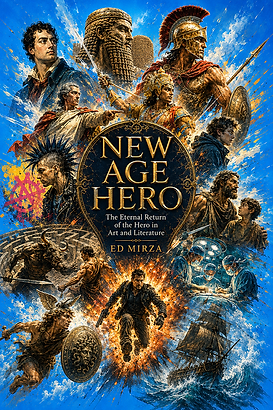
New Age Hero: The Eternal Return of the Hero in Art and Literature
Author: Ed Mirza
Genre: Cultural philosophy / Art and literary history / Speculative psychology
Themes: Heroism, the antihero, self-image, myth, masculinity, virtuosity, art and literature
Archival edition: Zenodo / Philosophy record: PhilPapers - link forthcoming
Conflicts in Heroism
There is a slight conflict persistent in today’s attitude towards the concept of the hero. On the one hand, it is seen as overblown and politically incorrect; yet feats of bravery are still admired, and virtuosity revered.
The Relatively Short Time Span of the Human Project
Since, on the greater scale of things as we now conceive them, the human race may prove to be only a brief—thus far—episode, it is perhaps unsurprising that certain features of human existence should nevertheless appear strikingly constant: as obvious, one might say, as the noses on our faces.
“Incredulity toward metanarratives” (Lyotard, 1984, p. xxiv) was the name of the game, or clarion cry, of Postmodernism. Since then, however, it increasingly seems that, rather than returning to ‘metanarratives’ or ‘grand narratives’, people are converging upon the idea of emergent truths: patterns or constants which reveal themselves through repeated observation rather than through philosophical imposition. This may offer a more empirical means of identifying certain primal qualities within human existence—again, perhaps, things ‘as plain as the noses on our faces’.
Phenomena of this kind might include those which seem almost pointless to contest, however one approaches their semantics: that the sun heats and illuminates; that human beings experience pain and hunger; that bodies are vulnerable; and so forth.
The asymmetry of the gametes, and its expression in the differentiated biological genders of the parents, may be considered alongside another curious circumstance of human existence. In a dynamic faintly reminiscent of the more primordial form of organic reproduction represented by the splitting of a cell, the human organism begins its existence within the female body and, for all practical purposes, initially as part of that same bodily system. Yet the developing child will itself ordinarily embody one or other biological sex, and must eventually emerge from this condition of profound physical continuity as a distinct organism.
As the child gradually comes to understand and represent itself within an interactive world, this passage from bodily dependence towards differentiation seems to correspond with another strikingly persistent feature of human existence: the construction of a stable sense of self - or an image or representation of itself, to itself. The connections between this process of self-representation and the recurrent presence of heroic motifs are explored here for the constants they may share. In effect, the essay traces not only the history of the hero, but the heroic history of the idea of the hero itself.
The First Human Hero — Heroism in Embryo
Born in the fabled cradle of civilisation, the Epic of Gilgamesh is among the earliest great works of literature to survive and present itself to us. Stories concerning Gilgamesh were brought together into Akkadian epic during the second millennium BCE and repeatedly transmitted and rewritten. Fragments travelled extraordinary distances through the ancient Near East, while themes from the poem—most famously its flood narrative—continued to echo through later religious and literary traditions.
Gilgamesh begins not as a saint but as an overbearing king: magnificent, powerful and objectionable. His friendship with Enkidu enlarges him; Enkidu’s death breaks him. The heroic journey consequently changes direction. Having defeated monsters, Gilgamesh encounters something that strength cannot defeat and begins the impossible quest to escape mortality. A. R. George neatly characterises the central theme as “the vain quest of a man to escape his mortality” (George, 2010, p. 1). The poem becomes less a simple celebration of conquest than a meditation upon the limits of human existence.
Gilgamesh’s heroism initially appears in the ancient language of distance, ordeal and extraordinary action. Yet the outward journey quickly acquires an existential dimension. In Robert Temple’s verse rendering:
“He crossed to the far shore, traversed the vast sea to the rising Sun.
He explored the rim, sought life without death.”
— The Epic of Gilgamesh, trans. Robert Temple, Prologue, p. 11
The geographical edge of the world becomes inseparable from the psychological limit of the self. Gilgamesh is dissatisfied with mortality despite being himself, in mythic terms, two-thirds divine. The paradox is almost comic in its grandeur: the being who appears nearest to escaping ordinary human limitation is precisely the one most violently confronted by it.
The poem’s treatment of Enkidu’s death makes this explicit. Gilgamesh covers his friend’s face, paces in grief, and cries out in terror at the discovery that what has happened to Enkidu will also happen to him. The death of the other produces an image of the future self. The hero who has overcome the external world encounters himself as a mortal creature.
“He covered, like a bride, the face of his friend …
Like a lioness deprived of her cubs, he paced to and fro, this way and that …
‘I shall die, and shall I not then be as Enkidu? … Sorrow has entered my heart!’”
— The Epic of Gilgamesh, trans. Andrew George, Tablets VIII–IX, pp. 65, 70
There is already something surprisingly modern here. Gilgamesh does not interest us merely because he defeats Humbaba. He has, amongst other things, an ego problem. He must discover the limits of himself, be broken by grief, move beyond the familiar world and return with a transformed understanding of what it means to be alive. The exterior adventure has an interior corollary almost from the beginning.
Yet this interior life is still represented with a curious exteriority. Psychological disturbance frequently appears almost as something that happens to Gilgamesh rather than as an interior world continuously explored by the narrative. On the journey to the Cedar Forest, for example, “Gilgamesh rested his chin on his knees, / sleep fell upon him, that spills over people.” He wakes startled and then recounts the dream to Enkidu, who interprets it for him. The inward event is rendered as dream, bodily sensation and external sign rather than extended introspection. (Tablet IV, trans. Andrew George; p. 30.)
The poem itself subsequently underwent a strangely heroic resurrection. Lost to modern culture for centuries, it re-emerged piecemeal from broken cuneiform tablets during the nineteenth century. The decipherment of Tablet XI caused a sensation because its flood narrative bore conspicuous similarities to Genesis: divine destruction, a warned survivor, a great vessel and the preservation of life. A story which had apparently vanished descended into historical oblivion and returned.
The hero therefore appears near the beginning of written literature at a peculiar frontier between history, mythology, religion and cosmology. Humanity has repeatedly projected meaning into the heavens, reading the stars as though they contained an enlargement of its own stories. Even controversial ethnographies such as the famous twentieth-century accounts of Dogon knowledge of Sirius belong to this strange territory. Later fieldwork challenged much of what had been attributed to the Dogon, but the persistence of the fascination remains revealing.
In such senses, the hero seems connected with the very origins of the human ‘project’, if it may be described as such. With its iridescent resonances with the Book of Genesis, Gilgamesh appears almost intrinsically bound to the very apparatus of human existence: mortality, self-recognition, cosmological projection and, perhaps, a built-in predisposition towards heroic conceptualisation.
The Hero in the Flesh — Greece
The Greek heroes inherit this gigantic scale. They emerge from a mythic world whose oldest strata contain tantalising, if obscure, correspondences with Near Eastern narratives—not least in the more distant cosmogonic accounts of Hesiod and the Titans.
Achilles is almost incandescent with heroic ability, yet he is also petulant, grief-stricken and terrifying. Odysseus is courageous but cunning, theatrical, deceptive and endlessly resourceful. Theseus, Perseus and Heracles inhabit a world of monsters and impossible tests, but Greek literature does not require its heroes to be morally uncomplicated. Extraordinary capacity and extraordinary defect can reside within the same body.
Sarpedon’s speech in the Iliad captures something essential about this heroic consciousness. He imagines, only to reject, the possibility of escaping battle altogether:
“Ah my friend, if you and I could escape this fray
and live forever, never a trace of age, immortal,
I would never fight on the front lines again …
But now, as it is, the fates of death await us,
thousands poised to strike, and not a man alive
can flee them or escape—so in we go for attack!”
— Homer, The Iliad, trans. Robert Fagles, Book XII, lines 374–380, pp. 335–336
Heroic action is not based upon ignorance of mortality but upon consciousness of it. The warrior advances because death cannot ultimately be escaped. The heroic gesture is made inside the knowledge of finitude.
Human Vulnerability in Greek Tragedy
Greek tragedy carries the contradiction further. Its central figures suffer, misunderstand themselves, make disastrous choices and encounter circumstances beyond their control. Heroism becomes interesting precisely where aspiration meets necessity, fate, ignorance and ordinary human frailty. Oedipus is formidable because his intelligence cannot rescue him from what he does not know; Ajax’s greatness cannot protect him from humiliation; Agamemnon’s status does not exempt him from moral catastrophe.
One can already see here what is arguably a distant precursor of what will later become the antihero. In Euripides’ Heracles, the great hero has been driven mad and killed his own children. Theseus struggles to reconcile the shattered man before him with the legendary figure:
“Are these indeed the words of Heracles, the much-enduring?”
Heracles replies:
“Endurance must have a limit.”
— Euripides, Heracles, trans. E. P. Coleridge, lines 1348–1350
The archetype of superhuman endurance discovers that he possesses a human breaking point. There are echoes here of what will later be regarded as ‘anti-heroic’: human frailty appearing almost ironically against the scale of the heroic exemplar. These figures remain enormous enough for myth, but they are already fissured by the recognisably human.
This becomes important later. The antihero only makes sense because the heroic model remains somewhere behind him. He is not necessarily the opposite of the hero; he is often the collision between heroic aspiration and the ordinary vicissitudes, weaknesses and absurdities of human existence.
Exteriority to Interiority
The ancient world is not devoid of interior life, but the internal world of its protagonists is represented differently from that of later European literature. Gilgamesh’s suffering appears through lamentation, dream, gesture and physical wandering. Homeric emotions are spoken, enacted, pleaded and fought across the visible world. The distinction is therefore not the presence or absence of psychology, but the means by which that psychology is represented.
Erich Auerbach, in the opening chapter of Mimesis, identifies in Homer the tendency:
“to represent phenomena in a fully externalized form, visible and palpable in all their parts.”
— Erich Auerbach, Mimesis: The Representation of Reality in Western Literature, trans. Willard R. Trask, Chapter 1, p. 6
Psychological processes are frequently treated in a similar manner. Characters speak what they think and feel. Grief becomes lamentation; fear becomes flight or speech; divine disturbance becomes dream or omen. The psychology is real, but it has not yet become the enormous private chamber that it will become in later literature.
A Homeric death can be rendered with terrifying brevity: the warrior falls, darkness or mist covers his eyes, and the narrative moves on. Compare this with the minute fluctuations of embarrassment, desire, jealousy, self-deception and memory that will occupy hundreds of pages in Tolstoy, Proust or Joyce. The subject has not suddenly acquired an inner life; rather, literature has progressively made the inner life into an increasingly elaborate representational space.
The Iliad repeatedly marks death through such stark formulations as “black night came swirling down across his eyes” or “the dark came shrouding down across his eyes.”
— Homer, The Iliad, trans. Robert Fagles, Book V, p. 186; Book XIII, p. 360
Something like a movement can therefore be traced from exteriority towards interiority. The ancient hero is not without psychology. Psychology has simply not yet become the principal landscape through which the hero must travel.
Across the centuries, then, literature makes a very discernible journey inward, towards increasing psychological depth.
Rome and Christendom
Rome produces another transformation of the heroic ideal. In Virgil’s Aeneas, heroic identity is increasingly bound to pietas: duty to gods, ancestors, family and a civilisation still to come. Heroism becomes not merely an eruption of individual prowess but the subordination of the individual to something larger than himself. The hero may conquer precisely by accepting an obligation he did not choose.
After the storm in Book I, Aeneas encourages his exhausted followers while concealing his own despair. Virgil makes the division between outward heroic appearance and inward suffering explicit:
“he feigns hope on his face, and keeps his anguish hidden deep in his breast.”
— Virgil, The Aeneid, trans. J. W. Mackail, Book I, line 209
Something significant has happened. The hero now performs courage for the sake of others while privately experiencing its opposite. Heroism is already partly theatrical: the stable exterior is maintained against an unstable interior. We have also moved another increment towards increased interiority.
Christianity permits another alteration. The martyr, saint and pilgrim can inhabit recognisably heroic structures while reversing many values of the warrior. Victory may consist in suffering; strength can appear as humility; conquest may be over temptation or sin rather than another people. Death itself can become passage rather than defeat. The old structure of ordeal, descent and return survives, but its field of operation becomes moral and spiritual.
Dante provides one of the great syntheses. The Divine Comedy is at once journey, vision, pilgrimage and extraordinary adventure, while Classical antiquity continually resurfaces within its Christian architecture. The protagonist travels through impossible worlds and encounters monsters, sinners, saints and exemplary figures, yet the ultimate object of the journey is a transformation of consciousness.
Medieval Christianity therefore did not simply erase the heroes and masters of antiquity. Dante makes Virgil, the Roman poet, his literal guide through the underworld and greets him in language bordering upon hero-worship:
“O, of the other poets honour and light …
Thou art my master, and my author thou.”
— Dante, Inferno, trans. Henry Wadsworth Longfellow, Canto I, lines 82–85
The Classical exemplar has been absorbed into a Christian journey of salvation. The master survives, but his function has been transformed.
Renaissance — The Classical Hero’s Return
The hero blossoms—indeed, bodies—forth again during the Renaissance. While the period is resolutely distinct from the later eighteenth-century movement described as Neoclassicism, it is emphatically a return to the Classical. Greek and Roman bodies, philosophies, myths and conceptions of individual accomplishment become newly available within Christian Europe.
The human figure consequently assumes extraordinary centrality. The love of God and the new confidence in human possibility coexist during this period; hero-worship and the idealisation of the body breathe alongside religious devotion.
Michelangelo’s David embodies this renewed heroic confidence. The figure is Biblical, Classical and Renaissance at once: an idealised human body representing not merely strength but the suspended instant before courageous action. The hero has become flesh with extraordinary intensity.
At the same time, the Renaissance elevates the artist himself. The painter, architect, sculptor, poet or polymath can increasingly become an exceptional individual whose abilities appear to exceed the ordinary. Michelangelo, Leonardo and Raphael become not simply craftsmen but exemplary figures. The idea of the master assumes new proportions. The artist can now function almost as another species of hero: a demonstration of what concentrated human capacity can become.
Literature, however, continues to complicate the model. Hamlet possesses many outward qualifications of the heroic protagonist and yet finds heroic action almost impossibly entangled with consciousness. Reflection, which might once have supported action, begins to interfere with it. The capacity to see too many possibilities becomes itself an impediment.
This interiority is especially notable in Hamlet, and symptomatic of the ineluctable movement inward both in humanity and in its literature.
Baroque and Rococo — Candlelight and Illusion
The Baroque introduces another kind of instability. Movement replaces repose; theatricality, illusion, sensuality, darkness and sudden illumination complicate Classical equilibrium. The period can at moments feel tantalisingly close to later Romantic sensibility: ecstatic saints, stormy heavens, shadow, music, emotional abandon and elaborate imaginary worlds. Yet it would be too neat to call the Baroque merely a premature Romanticism.
The Baroque is associated with theatrical chambers and a strange hinterland of private reverie: the faintly mesmeric sound of the lute and mandolin, figures caught between performance and introspection, and elaborate fantasy worlds whose boundaries seem less secure than those of the Classical imagination. Germain Bazin describes the Baroque artist as one who:
“longs to enter into the multiplicity of phenomena, into the flux of things in their perpetual becoming.”
— Germain Bazin, Baroque and Rococo, trans. Jonathan Griffin, pp. 6–7
The compositions become “dynamic and open” and tend to expand beyond their boundaries. Elsewhere he describes an instinctive preference for “forms that take flight” (Bazin, 1964, p. 7).
This formal distinction is suggestive beyond form. Classical compositions remain comparatively bounded and self-contained; Baroque forms intermingle, dissolve and escape. It would be excessive to turn an art-historical distinction directly into a psychological law, but an analogous movement is difficult not to notice: away from the self-possessed figure and towards a more porous creature acted upon by sensation, music, atmosphere and emotion.
In Dutch interiors Bazin describes the room as:
“a secret place, a refuge of private life”
where figures “indulge in music or in conversation” or sit “pensive and alone”, conscious of “the sadness of the human condition.”
— Germain Bazin, Baroque and Rococo, trans. Jonathan Griffin, p. 100
Particularly interesting in this respect is Bazin’s observation about the lute, an instrument strongly associated with the sound-world of the Baroque. A particularly striking example of its curiously mellifluous and otherworldly character can be heard in Antonio Vivaldi’s Chamber Concerto in D major, RV 93, for lute, two violins and continuo—above all in its second movement, the Largo, which can sound, to modern ears, strangely and unexpectedly contemporary.
“the plaintive lute became a favourite instrument in Italy and later in France. Its effects on the human psyche were thought to be so pernicious that preachers and moralists joined in condemning it.”
— Germain Bazin, The Baroque: Principles, Styles, Modes, Themes, p. 206
Bazin immediately cites contemporaries who described listeners as “bereft of their senses” and habitual players as “fantastical dreamers” (Bazin, 1978, p. 206). The heroic body has not disappeared, but the centre of attention begins to move elsewhere. The individual listens, remembers and dreams. The faintly mesmeric lute becomes almost emblematic of this softer boundary between person and atmosphere.
Heinrich Wölfflin consequently insisted that Baroque should not simply be understood as the deterioration of a Classical ideal:
“Baroque … is neither a rise nor a decline from classic, but a totally different art.”
— Heinrich Wölfflin, Principles of Art History, trans. M. D. Hottinger, p. 14
For Wölfflin, Classical and Baroque art represent different organisations of vision rather than superior and inferior points on a single developmental curve.
Bazin takes the psychological suggestion considerably further elsewhere. He detects in certain Baroque figures an “indefinable air of slightly raffish romanticism, even of buffoonery”, accompanied by what he calls a “picturesque burlesque amusement”. Behind this apparent playfulness, however, he perceives something darker: an instinctive apprehension of a tragedy threatening civilisation which has not yet fully crossed the threshold into consciousness. Feeling escapes sideways into fantasy, game and pose.
— Germain Bazin, The Baroque: Principles, Styles, Modes, Themes, p. 210
This is remarkably close to an incipient psychology of Romanticism. The strange landscape, theatrical fiction, grotesque figure and half-dreaming chamber can be understood not merely as decorative excess but as signs of an interior world beginning to press against the harder boundaries of the Classical self. Bazin’s description of Salvator Rosa—crags, ravines, dramatic light, bandits, witches and hermits—already points towards the Romantic picturesque (Bazin, 1978, p. 210).
Rococo pushes aspects of this world towards intimacy, pleasure, fantasy, elegance and apparent frivolity. Classical severity does not disappear, however; it remains available as a counter-current. The eventual Neoclassical reaction to Baroque and Rococo excess therefore feels less like the invention of a new language than the emphatic return of an old one.
It is, once again, an emphatic return of the Classical hero.
Neoclassicism — Heroic Severity
Developments in visual art and literature now proceed in strikingly parallel ways. The heroic survives with extraordinary explicitness in eighteenth-century Neoclassicism, but its flamboyance is disciplined. Jacques-Louis David’s paintings place self-sacrifice, public duty, stoic austerity and civic virtue at their centre. The Oath of the Horatii, The Death of Socrates and Leonidas at Thermopylae ask the spectator to confront human beings who subordinate convenience, pleasure and even survival to an exemplary principle.
Hugh Honour, writing in Penguin’s exemplary Style and Civilization series, describes the tone of Neoclassicism in terms particularly useful here:
“David extols an heroic world of simple, uncomplicated passions and blunt, uncompromising truths.”
— Hugh Honour, Neo-classicism, p. 34
Elsewhere, he observes that “artists and patrons prefer those which illustrate grandeur of soul, heroic deeds, simple, powerful passions” (p. 66).
This is the hero not primarily as colourful adventurer but as exemplar. David’s Socrates or Leonidas occupies an imagined extremity of conviction: this is what a person might do if duty, courage or belief were pushed to their limit.
Whether one agrees with the values embodied is a different question from recognising what the image asks of us. It asks us to contemplate somebody who goes further than ordinary convenience would permit.
The political consequences of this exemplary mode are necessarily ambiguous. Civic virtue can slide into nationalism; patriotic self-sacrifice can become militarism. But that ambiguity does not abolish the exemplary function. It reveals its power.
It would be too simple to suggest that Neoclassical heroism was produced by war: David’s Oath of the Horatii and Death of Socrates both precede the French Revolution. Yet their language of sacrifice, stoic resolution and civic duty found an extraordinarily charged setting in the Revolutionary and Napoleonic age. David’s own career makes the progression unusually visible. The exemplary heroes of antiquity give way first to the heroes and martyrs of Revolution and finally to Napoleon himself, monumentalised as commander and almost providential leader. War did not create the Neoclassical hero, but it provided this already heroic visual language with a powerful contemporary arena.
Romanticism and the Antiheroic Image of the Self — Extravagance, Inwardness, Escapism and Revolt
Romanticism creates one of the decisive alterations in the history of the exemplary individual. Hugh Honour characterises its assertion of independence particularly well:
“Romantics were claiming the right to go their own way unhelped and unhindered—in order to develop their individual sensibilities and express their innermost feelings without regard to, and often in defiance of, theoretical values and social conventions.”
— Hugh Honour, Romanticism, p. 245
The hero is no longer required to embody the accepted values of the polis. Indeed, heroism may now consist precisely in estrangement from prevailing values. The solitary artist, rebel, exile, wanderer and misunderstood visionary become possible heroic types.
The French Revolution helps transform the political imagination, while the Sublime enlarges the experiential horizon. Mountains, storms, abysses and ruined civilisations become outward correlatives for the increasingly gigantic interior world. The Romantic artist does not simply depict extremity; he becomes a traveller towards the limits of experience.
At one outer edge of this Romantic inheritance stood Thomas Carlyle, who sought to fuse inwardness, transcendence and individual greatness with more Classical and civic ideals of exemplary action. His hero-worship found a close contemporary parallel in Ralph Waldo Emerson’s celebration of ‘representative men’, while his emphasis upon exceptional individuals anticipates themes that would later reappear, in a very different and more critical form, in Nietzsche.
Carlyle subsequently constructed an almost impossibly emphatic theory of exemplary individuals in his 1840 lectures On Heroes, Hero-Worship, and the Heroic in History. His claim that history could fundamentally be explained through Great Men is difficult to accept as historical method.
“I mean to shew that ‘Hero-worship never ceases,’ that it is at bottom the main or only kind of worship.”
— Thomas Carlyle, letter to John A. Carlyle, 2 March 1840, Collected Letters, vol. 12, p. 67.
“The Hero is he who lives in the inward sphere of things, in the True, Divine and Eternal, which exists always, unseen to most, under the Temporary, Trivial …”
— Thomas Carlyle, On Heroes, Hero-Worship, and the Heroic in History, Lecture V, “The Hero as Man of Letters,” p. 150
Yet another of his pronouncements is considerably harder to dismiss:
“Hero-worship exists forever, and everywhere.”
— Thomas Carlyle, On Heroes, Hero-Worship, and the Heroic in History, Lecture VI, “The Hero as King,” p. 196
There is a sense in which Carlyle’s hero-worship can be read as a reaction against the more self-defeating possibilities of Romantic inwardness. The Romantic individual may become so absorbed in feeling, alienation and estrangement that the heroic journey ceases to move outward at all. There is consequently an ambiguity within the Romantic hero. Intense individuality can make the figure heroic, but the same alienation may make him neurotic, escapist, self-destructive, morally ambiguous or hostile to the world he occupies. The Byronic hero is both enlargement and fracture.
The Antihero — The Admission of Human Frailty
It is within this Romantic inheritance that we begin to encounter a more conspicuous fascination with defeat, ineffectuality and escapism—not simply as failures of heroism, but as experiences capable of occupying the centre of the work themselves.
Byron embodies the contradictory type almost too perfectly. Childe Harold is marked by exhaustion, estrangement and self-disgust:
“And Vice, that digs her own voluptuous tomb,
Had buried long his hopes, no more to rise:
Pleasure’s pall’d victim! life-abhorring gloom
Wrote on his faded brow curst Cain’s unresting doom.”
— Lord Byron, Childe Harold’s Pilgrimage, Canto I, stanza LXXXIII
Here the extraordinary individual no longer needs simply to overcome the world. He may be partly at war with himself.
Goethe’s Werther gives private feeling similar magnitude. His anguish becomes the principal event:
“all my active energies have been cast down into restless listlessness, and I can neither be idle nor accomplish anything.”
— Johann Wolfgang von Goethe, The Sorrows of Young Werther, trans. Michael Hulse, 22 August, p. 67
Neither Werther nor Byron’s protagonists are antiheroes in precisely the later twentieth-century sense, but both belong to the transformation which makes the antihero possible. The exceptional individual no longer needs to conquer Troy.
Realism intensifies the process by removing much of the mythic licence traditionally granted to heroes. Human beings are compromised by money, marriage, sex, class, cowardice, boredom, illness, social expectation and their own ridiculousness. As literature becomes increasingly fascinated by ordinary consciousness, the uncomplicated heroic figure becomes difficult to sustain without qualification.
The antihero is born from this difficulty.
But the antihero may not be the negation of the hero. He may be what happens when the hero survives realism. He has lost the perfect body, uncomplicated motive and convenient divine ancestry, but narrative still follows him because the ancient question has not vanished:
What will this person do with the fact of being himself?
The Brave New World of the Modernist Hero
Modernism appears at first to complete the destruction. Coherent narrative fractures. Perspective multiplies. Certainty about the self becomes increasingly difficult to sustain. The protagonist may be ordinary, alienated, passive or almost impossible to distinguish from the surrounding flow of consciousness.
The First World War also became an enormous catalyst for tendencies that were already developing, particularly within the successive waves of Modernism in visual art. The unprecedented mechanisation of destruction appeared to shatter not simply lives and nations but assumptions about civilisation itself. Empires collapsed; an older European world of rattling hooves, inherited hierarchies and comparatively primitive industrial technologies seemed abruptly to recede into the past.
T. S. Eliot’s The Waste Land, published in 1922, is perhaps one of the most vivid allegorical attempts to register something of the collective consciousness immediately after that rupture. Its fragments of literature, religion, conversation and cultural memory inhabit a civilisation which still possesses the remains of its inherited structures but no longer seems entirely able to inhabit them with confidence.
And then Joyce performs a peculiar resurrection in Ulysses, a work whose closing inscription is itself strangely evocative of the unsettled European world through which it was made:
“Trieste—Zurich—Paris, 1914–1921.”
— James Joyce, Ulysses, Episode 18, concluding inscription p. 644
Leopold Bloom is Odysseus.
Even within the novel, Bloom is glimpsed as something faintly more than his apparently ordinary circumstances suggest:
“He's a cultured allroundman, Bloom is, he said seriously. He's not one of
your common or garden ... you know ... There's a touch of the artist about
old Bloom.”
— James Joyce, Ulysses, ed. Hans Walter Gabler, Episode 10, lines 581–583 p. 193
The ordinary movements of Ulysses take place inside an ancient heroic architecture. Bloom’s day is absurdly small beside the wanderings of Odysseus, and yet the disparity is precisely the point. The enormous myth and the ordinary man occupy the same imaginative space.
This is a crucial transformation. Once the psychologically plausible modern individual can no longer comfortably resemble Achilles, Achilles and Odysseus can become invisible scaffolding. The hero survives after the heroic surface has disappeared.
The heroic also returns in a harder register. Hemingway’s famous formulation condenses the modernist ethic:
“But man is not made for defeat,” he said. “A man can be destroyed but not defeated.”
— Ernest Hemingway, The Old Man and the Sea, p. 103
The hero is no longer magically protected by divine ancestry. Strength consists in facing a world without guarantees.
Even Eliot’s ruined modern landscape retains a strangely heroic act of salvage:
“These fragments I have shored against my ruins.”
— T. S. Eliot, The Waste Land, V, “What the Thunder Said,”
The modern hero may therefore survive less by triumphing over the world than by preserving some coherent remnant of the self within it.
Aldous Huxley’s Brave New World carries this crisis of heroic value into dystopia. John the Savage attempts to defend ideas of nobility, suffering, individuality and spiritual seriousness against a civilisation which has systematically removed the conditions in which such values might arise. His resistance ends not in heroic victory but in psychological collapse and, ultimately, self-destruction. The novel thereby stages, in deliberately dramatic form, the possible annihilation of heroic value itself—not as a moral recommendation, but as a warning about what may be lost when comfort, efficiency and social stability become absolute ends.
Mustapha Mond states the principle of that world with chilling clarity:
"Civilization has absolutely no need of nobility or heroism. These things are symptoms of political inefficiency. In a properly organized society like ours, nobody has any opportunities for being heroic."
— Aldous Huxley, Brave New World, ch. XVII, pp. 194–195
Postmodern Nihilism — Relativism and Suspicion
Throughout the developments of Modernism, and more broadly from the Enlightenment and the critical spirit surrounding the French Revolution onwards, habits of scepticism and analysis gathered force, eventually extending into the realms of structuralism, poststructuralism and deconstruction.
A line of thought beginning with Cartesianism is relevant here. The separation of thinking subject from extended world, and the corresponding primacy accorded to thought, can encourage a detachment of observer from observed, thought from feeling, and mind from embodied experience. What might previously have been experienced as deeply rooted in the body, history or inherited structure can consequently be reconfigured as representation, convention or programming.
Taken far enough, such a position can suggest that thought and symbolic representation constitute almost everything that human beings are: that identity itself is, to a remarkable degree, programmable.
At its most radical, this way of thinking can lead to suspicion of many structures formerly regarded as stable or natural: hierarchy, merit, behaviour, gender, identity and even the idea of objective excellence. Such scepticism can be gathered under the familiar Postmodern phrase “incredulity toward metanarratives” (Lyotard, 1984, p. xxiv), or suspicion of grand narratives. The ideas of exalted merit, genius, virtuosity and heroism can all fall into the same category of phenomena to be regarded with suspicion.
In contemporary argument, this broader cluster of relativism, social construction, suspicion of hierarchy and analysis of power is sometimes collectively described—often rather loosely—as Marxist. The description is not entirely baseless, since Marxist thought contributed profoundly to the analysis of class, ideology, material conditions and the social production of apparently natural distinctions. Yet the genealogy is more mixed than the label suggests: structuralism, poststructuralism, psychoanalysis and other traditions also feed into it, while Marx himself was hardly a relativist in the simple sense. The modern use of ‘Marxism’ can therefore function as a convenient umbrella term for a much wider family of critical attitudes.
Such criticality unquestionably has its merits. It is conceivably better to arrive at convictions not merely through suggestion, authority or inherited convention, but through direct experience, scrutiny and independent verification.
Yet if this impulse is itself fuelled by petty resentment, false iconoclasm or the desire merely to overturn what has previously been admired, its result can become nihilistic. The hero, the genius and the virtuoso may then become associated almost automatically with elitism, oppression, chauvinism or exclusion, and met with little more than eye-rolling or sneering.
This attitude belongs to the wider suspicion of grand narratives and, followed to one of its possible conclusions, may imply that there is no entirely stable self beneath the various symbolic representations through which identity is constructed. A blasé, ironic and falsely iconoclastic impulse can emerge alongside this: one which appears to distrust not merely particular heroes, but idealism, Classical heroism, mastery and even the aspiration towards skill itself.
There is also a familiar cultural caricature here: the idea that certain people simply “cannot identify with anything after the seventeenth century.” The phrase is obviously imprecise, but it captures a recognisable divide between those instinctively attached to older conceptions of merit, human nature and value, and those more at home in the sceptical, analytic, and relativising traditions that followed. It is too broad to describe people neatly, and there are innumerable overlaps, but as a cultural meme it points towards a real tension in modern attitudes.
Postmodern fiction consequently becomes filled with protagonists who lose the plot in a more literal sense. Paul Auster’s characters wander through cities and identities which seem to dissolve beneath them. Vonnegut presents human beings as the playthings of enormous historical forces. DeLillo’s worlds are saturated by images and systems which make the distinction between authentic self and cultural representation increasingly unstable.
“There are almost no characters in this story, and almost no dramatic confrontations, because most of the people in it are so sick and so much the listless playthings of enormous forces. One of the main effects of war, after all, is that people are discouraged from being characters.”
— Kurt Vonnegut, Slaughterhouse-Five, Chapter 8, p. 164
“We’re not here to capture an image, we’re here to maintain one. Every photograph reinforces the aura.”
— Don DeLillo, White Noise, Chapter 3, p. 12
“New York was an inexhaustible space, a labyrinth of endless steps ... it always left him with the feeling of being lost. Lost, not only in the city, but within himself as well.”
— Paul Auster, The New York Trilogy, “City of Glass,” pp. 3–4
The heroic project—to make a meaningful self acting purposefully through the world—has become questionable.
Postmodern Susceptibility to Heroism
The same people who greet virtuosity, notions of heroism and the like with rolling eyes and suspicion may nevertheless act in ways which contradict that first stance. Virtuosity may be treated as elitist; mastery as authoritarian; greatness as a category constructed by privilege. Yet these attitudes frequently coexist with behaviour suggesting that admiration has proved considerably harder to abolish.
People who profess incredulity towards greatness—and, more broadly, an “incredulity toward metanarratives”—still queue to see Leonardo. They listen in silence to an extraordinary singer. They watch athletes perform things their own bodies cannot perform.
They cry at adventure films.
They may become moved by the story, for example, of a tiny doggy entering a burning house to save its master. This doggy may not have Thomas Carlyle as its bedtime reading, and it may not keep a copy of the Odyssey beside its basket, but the act resonates unmistakably with the ancient patterns of heroism.
The culture may consequently maintain a curious compromise. The heroic deed is retained, but the word heroic is provisionally placed inside inverted commas. Irony becomes a permission mechanism through which admiration can survive suspicion.
The Journey Inwards
Joseph Campbell is now perhaps the most famous modern commentator upon the heroic structure. The Hero with a Thousand Faces has migrated far beyond comparative mythology into cinema—most famously in its influence upon Star Wars—as well as psychology, advertising, self-help and management theory.
Campbell describes the “nuclear unit” of the mythological adventure as:
“separation — initiation — return.”
— Joseph Campbell, The Hero with a Thousand Faces, p. 30
The hero leaves the familiar world, undergoes transformative ordeal and eventually returns. Campbell often interprets this movement psychologically, and his account bears obvious affinities with both Freud and Jung.
Shamanic initiation supplies an especially vivid image. Across numerous traditions, the initiation of the shaman can involve symbolic dismemberment, death, descent, dissolution and magical reconstruction. The individual who returns has crossed a boundary inaccessible to ordinary experience.
The reconstructed shaman is close to the hero for the same reason: both have survived a journey beyond the ordinary limits of the self.
The relationship between the heroic journey and psychic transformation has by now entered popular consciousness almost to the point, one might say, of ad nauseam.
Yet Campbell’s theory also has numerous points of convergence with Freud’s Oedipal complex, and it is here that the heroic journey begins to intersect more directly with the formation of the self.
The Oedipal Complex — The Ineluctable Imperative of Self Image
While organic reproduction had rudimentary beginnings in the splitting of the cell, this developed, in a fascinating manner, into an asymmetry of the gametes which can be seen as part of the architecture underlying the organisation of mammals—including humans—into binary genders.
The resulting method of reproduction resembles, in one respect, the initial curious autonomous process of one cell producing another, with the crucial difference that, in humans, the new organism—the child—develops within the mother. Birth itself therefore bears a curious resemblance to a process of separation: that is to say, the child begins life, for all intents and purposes, as part of the body of the mother.
Thus it is understandable that, having gestated within the mother’s womb and emerged into this mysterious universe, the child should feel an overwhelming attachment to the mother and resist outside interference which appears to threaten that bond—an acute form of separation anxiety, one might say.
Thus, when (what very conceivable may seem to the child) an ogre-like figure whom the child is told is its father appears intermittently—someone whom it may dimly perceive both to resemble itself and, at some level, to have been instrumental in its very creation—an ambivalence is entirely conceivable. The figure may be experienced by turns as a threat to the bond with the mother and, alternatively, as the loving figure which he may well be. He can seem as an ogre like usurper of the mother’s love.
The saga of the Oedipal Complex is the famous account of this extraordinary triangulation which appears to occur in human development and which reflects, in symbolic form, the very circumstances through which human beings are created.
Within this account, the child transcends and develops beyond the infantile relationship with the mother through reconciliation with the father, overcoming the ambivalence and negativity initially directed towards him.
A failure to do so may result in a negative image of the father which, in turn, contributes to a negative self-image in the child—colouring the way the child represents itself to itself, and the modus operandi it develops for functioning sustainably in the world.
In a very conflicted way, the negative self image derived from the negative perception of the father, impacts on the way the child feels capable of receiving love from the mother - since of course the child wants to disrupt the affection between the mother and father, but at some level personally embodies that father.
Thus the phrase ‘positive identification with the father’ becomes pivotal in descriptions of a successfully navigated Oedipal Complex.
While many permutations are possible within the nuclear arrangement of a family, so to speak, this can still be regarded as a template against which other variations on the model may be compared.
The crucial point is this process of self-representation: the construction of an image of oneself which is functional, and which serves the child over the long term.
When this process fails, and the negative or damaged self image is carried forward, in general, the child goes forward, ambivalent towards other men, ambivalent towards other women, and seeking to replicate subliminally, in a romantic sense, with the opposite gender, the conditions it perceived as necessary for receiving love from the parent of the opposite gender.
Hero-Seeking and Emulation as Linked to the Disrupted or Incomplete Self-Image
It is a tantalising possibility that this process of constructing a personal image is itself one of the emergent truths mentioned at the outset of this essay: a necessity as pressing and consistently experienced, in its own sphere, as the reproductive asymmetry from which human beings arise.
The way in which a human being negotiates its appearance in the world—having begun life almost as part of another body—is through representing itself to itself. That process, in turn, unfolds through the curious prism of its position between the two bearers of the asymmetric gametes from which it was produced: the biological mother and father. This is an interpretation based upon the strictest biological description of gender; in behavioural and cultural terms, people are of course free to identify through whatever permutation or admixture they find meaningful.
Within this biological template there nevertheless appears a strange and persistent constant. The more remote male figure—the biological father—enters the arrangement as an exterior presence who both resembles the child and stands apart from the original maternal bond. In this respect he bears, at least faintly, an intriguing resemblance to the similarly distant and somewhat unattainable figure of the hero.
Thus there appears repeatedly this pattern of an intervening, or at least exterior, force which helps establish separation between the child and the maternal organism of which it was once physically part. The mother is the object of intense attachment and separation anxiety; the father, being biologically related to the child within the primary template, becomes one of the most immediate exemplars of how that child—whether male or female—may eventually temper, adjust and extend its own self-image in order to create a workable interface with the wider world.
As mentioned above, when this process fails or remains incomplete, it is quite possible that the search for some kind of replacement exemplar begins with particular urgency. The yearning may even be proportional, in some degree, to the original separation anxiety surrounding the mother of whose body one was once physically part: an attempt to complete the sense of independence which has not yet been fully secured, perhaps by inwardly satisfying conditions once associated with receiving maternal love.
This could help explain the curious urgency, preoccupation or even compulsiveness which sometimes seems to characterise hero-adulation.
That, however, remains a relatively cynical account of hero-worship or the seeking of improving examples. It would stand to reason that individuals—men or women—who have reconciled themselves more or less harmoniously with each of the two biological parents who produced them, within the most basic template of the matter, might still admire and draw inspiration from people who accomplish remarkable things or perform impressive acts.
Yet there remains a commonality between the two cases. Both concern self-image, self-representation and the continuing adjustment of that representation in ways which enable a person to function over the long term within the world.
Virtuosity, Excellence and Self-Defining Accomplishment
In some senses, then, the ‘master’ assumes a father-like presence: the virtuoso, or exemplary practitioner, of any sport, art or discipline.
The acquisition and pursuit of skill can therefore be understood as a mode of developing and bettering oneself, with the most accomplished practitioners becoming, in effect, heroes and role models within that method of self-formation.
Irresistibly, this connects with the very heights of achievement and virtuosity, from boxing to the arts. This too may map onto the strong and persistent impulse to define oneself beyond the womb, and beyond the earliest conditions of dependence.
The Sensorial Line
The embryo of this idea was mentioned above in relation to the Renaissance, when the human form emerged as the locus of a monumental project. Humanism, so to speak, entered the Christian world, and with it came not only a renewed depiction of the human form but a renewed concentration upon the body as sensorium—the locus of all experience.
Quite apart from simple narcissism, the human being, as the site of all human experience, may quite legitimately be regarded, in every individual case, as the centre of the universe as experienced. The virtuoso line delineating the figure therefore acquires a particular significance. A cult of the human form, emerging with extraordinary force in the Renaissance, developed into a technical practice of such refinement that it simultaneously embodied both the most expressive of subjects and one of the most expressive and refined skills that a body itself could produce.
The Heights of Human Accomplishment
As has been observed before, the person in quest looks to the hero as an example and says:
‘Show me the limit of what a human being can be.’
Why Does Heroism Seem to Be So Important to Men?
Why is the emulation of heroes, or of otherwise admired individuals, so emphatically male? Why does it seem so pronounced for the male of the species?
It must also be said that, while many profoundly exemplary women exist—moral, courageous, skilful and meritorious—there remains something, quite apart from the linguistically masculine character of the word itself, persistently male about the idea of the hero. It could be argued, in the Postmodern critical sense, that this is largely the result of suggestion and cultural programming. Yet the phenomenon itself must still be examined if we are to exercise genuine criticality.
We have seen above that there is some resonance between the hero and the defining, image-modifying influence which the father can be understood to possess. Within the model established above, both father and hero may therefore become instrumental in the development of self-image.
There is an existential sense in which heroism seems peculiarly pertinent to, or resonant with, men. Women can of course save lives, perform acts of extraordinary bravery and perform many heroic acts / embody every quality associated with heroism; yet there seems less of a sense that heroic identification is quite as imperative, or as necessary, to the definition of the female self.
There is also a compelling, almost insistent sense that men must overcome some barrier or obstacle in order to feel fully realised in an existential sense.
One possibility is that, if there is indeed a connection between fathers and heroes of the kind described above, then the boy, while transcending the infantile relationship with the mother, may feel a stronger affinity with the father precisely because the father becomes instrumental in that transition.
There is certainly an extremely prevalent culture of boys and men bettering themselves through exemplary figures, and it often appears more pronounced than the equivalent tendency among girls. It can extend to almost every aspect of behaviour: manner, conduct, physical achievement, skill, discipline and style. There are, of course, female equivalents—traditional ideas of decorum or even the finishing school, for example—but something about the male version appears more existentially make-or-break, and perhaps more insistently bound up with the question of what kind of person one is to become.
Possibly the female child identifies more immediately with the mother, and so the transition from the separation-anxiety-ridden state of infancy—from the extraordinary condition of having once shared the mother’s body—requires a less seismic adjustment in bodily self-conception. The father may remain important, but the movement towards an adult female identity does not require quite the same crossing from one embodied gender to another.
For the male child, the transition may therefore feel more definitive and transformative.
Perhaps for men, having once shared—or, for all intents and purposes, been part of—the body of a woman, still such an extraordinary fact, the movement towards adulthood entails an additional transformation: the child must eventually embody the biologically opposite sex from the maternal body within which it began, and carries the other member of the asymmetric gametic pair.
Or perhaps—another well-known argument—this emphasis upon achievement and self-definition acquires added force for men because bearing a child is not available to them as an equivalent biological act of creation and continuity.
At all events, it seems permissible to suggest that heroism and exemplary self-fashioning may, on average, possess a greater existential importance for men, and that men may consequently give them greater emphasis when given the choice.
Some of the above might be summarised more simply in this way: the female child may receive part of her developing identity through continuity with the mother as a member of the same sex, whereas the male child must construct his adult bodily identity across a more conspicuous difference. If so, the corresponding drive towards individuation, exemplary identification and self-definition may carry a different—and perhaps greater—psychological magnitude for him.
The Persistently Re-Emergent Hero
Ironic comparisons with heroes are likely always to have been a source of humour, while exaggerated lampoons of superhuman qualities have likewise drawn amusement from the contradiction between the ideal and ordinary human frailty.
This differs from the more nihilistic suspicion that can accompany the extreme relativist positions considered above. Sympathetic irony and comic deflation are not the same as the reflexive dismissal that may attach itself to an incredulity towards metanarratives.
The antihero, too, may therefore have been a recurrent presence, arising from precisely this collision between human reality, mortality and heroic aspiration. Even the fatalism and despair that can seem to characterise the shattered Postmodern hero may not be entirely new, given the enduring reality of the human condition as it is pitched against fate, circumstance and the elements.
Within all this, however, one fact remains: the human experience of being an embodied self in an entirely mysterious situation—an unknown universe—brought into being through the extraordinary interchange between the bearers of the asymmetric gametes, its biological parents.
The emergent constant may indeed lie in this process itself: the continual negotiation and reconstruction of self-image discussed above, as persistent in human experience as the nose on one’s face. This may provide a more prosaic explanation not only for the recurrent nature of the hero, but for the extraordinary pervasiveness of heroism in all its scales: great and small, petty and personal, everyday and intimate, or grandiose and sweeping.
Action films, biographies, documentaries and ordinary news stories continue to reconstruct the form. Someone withstands impossible pressure. Someone refuses to capitulate. Someone rescues somebody else.
The hero returns and returns because human beings, whatever the zeitgeist, are compelled in each individual case to construct and reconstruct an image of themselves in order to operate in the world at all. That process necessarily gives rise to exemplary figures against which the self can be imagined, tested and revised.
The hero is a mirror.
The Eternal Return of the Hero
Through every permutation, one condition persists: human beings find themselves existing for a finite period within bodies and must construct sufficiently stable representations of themselves in order to act through the world.
This building of the self-image appears less like a philosophical luxury than an emergent condition of human existence.
The Romantic hero or antihero—even the transsexual or gender-nonconforming figure of the Postmodern era—remains, to some degree, heroic. Identity politics itself frequently follows the struggles of people to define themselves within particular contexts and across differing cultural registers, including what are now described as positions of ‘intersectionality’.
The development of a sense of self, an image of self, a functioning self capable of coexisting, surviving and flourishing may sound suspiciously like a grand narrative. Yet, in the final analysis, it does appear to possess an emergent and perhaps universal character. Indeed, emergence may prove a useful term precisely because it describes patterns which arise repeatedly without requiring the imposition of a single totalising system.
In any case, the central theme remains the construction and clarification of the self: the retaining of images which serve it, the rejection or reduction of those which do not, and the continual adjustment of the image through which the individual encounters the world. These processes map with curious persistence onto time-honoured accounts as old as the human record itself—as plain, perhaps, as the nose on one’s face.
It is in this same sense that the triangulation within the curious story arising from the bearers of the asymmetric gametes becomes relevant to self-image: development within, attachment to and eventual separation from the mother. The experience of beginning life within a womb is itself, within this analysis, another emergent constant.
As this essay has witnessed, the human story of the hero has undergone vicissitudes remarkably comparable to those it chronicles in human experience.
If the hero is ultimately one of the great instruments of the human project by which a person develops, tests and refines an image of the self - it can be regarded as a mirror: a,mirror that humanity holds up to itself and questions.
If the human is the centre of the universe, as all centres of experience must be - the universe experiencing itself - the hero is a mirror the universe holds up to itself.
Bibliography
Alighieri, Dante. The Divine Comedy: Inferno. Translated by Henry Wadsworth Longfellow. Houghton, Mifflin and Company, 1867.
Auerbach, Erich. Mimesis: The Representation of Reality in Western Literature. Translated by Willard R. Trask. Princeton University Press, 2003.
Auster, Paul. The New York Trilogy. Faber & Faber, 2008.
Bazin, Germain. Baroque and Rococo. Translated by Jonathan Griffin. New York: Frederick A. Praeger, 1964.
Bazin, Germain. The Baroque: Principles, Styles, Modes, Themes. Translated by Pat Wardroper. New York: W. W. Norton, 1978. Originally published 1968.
Byron, George Gordon, Lord. Childe Harold’s Pilgrimage: A Romaunt. London: John Murray, 1812
Campbell, Joseph. The Hero with a Thousand Faces. New York: Pantheon Books, 1949.
Carlyle, Thomas. On Heroes, Hero-Worship, and the Heroic in History. London: James Fraser, 1841.
Carlyle, Thomas, and Jane Welsh Carlyle. The Collected Letters of Thomas and Jane Welsh Carlyle: 1840. Vol. 12. Edited by Charles Richard Sanders. Durham, NC: Duke University Press, 1978.
DeLillo, Don. White Noise. New York: Viking, 1985.
Eliot, T. S. The Waste Land. New York: Boni and Liveright, 1922.
Euripides. “Heracles.” The Complete Greek Drama. Translated by E. P. Coleridge, vol. 1. Random House, 1938.
George, Andrew, trans. The Epic of Gilgamesh: The Babylonian Epic Poem and Other Texts in Akkadian and Sumerian. Penguin Books, 2003.
George, A. R. “The Epic of Gilgamesh.” In The Cambridge Companion to the Epic, edited by Catherine Bates, 1–12. Cambridge University Press, 2010.
Goethe, Johann Wolfgang von. The Sorrows of Young Werther. Translated by Michael Hulse. Penguin Books, 1989.
Hemingway, Ernest. The Old Man and the Sea. New York: Charles Scribner’s Sons, 1952.
Homer. The Iliad. Translated by Robert Fagles. Penguin Books, 1990.
Honour, Hugh. Neo-classicism. Reprinted with revisions. Harmondsworth: Penguin, 1977.
Honour, Hugh. Romanticism. New York: Harper & Row, 1979.
Huxley, Aldous. Brave New World. London: Chatto & Windus, 1970.
Joyce, James. Ulysses. Edited by Hans Walter Gabler. Random House, 1986.
Lyotard, Jean-François. The Postmodern Condition: A Report on Knowledge. Translated by Geoff Bennington and Brian Massumi. University of Minnesota Press, 1984.
Temple, Robert, trans. He Who Saw Everything: A Verse Version of the Epic of Gilgamesh. Rider, 1991.
Virgil. The Aeneid of Virgil. Translated by J. W. Mackail. London: Macmillan and Co., 1885.
Vonnegut, Kurt. Slaughterhouse-Five, or, The Children’s Crusade: A Duty-Dance with Death. New York: Dell Publishing Co., 1969.
Wölfflin, Heinrich. Principles of Art History: The Problem of the Development of Style in Later Art. Translated by M. D. Hottinger. Dover Publications, 1950.